Researchers at IASST developed a new Ni-doped TiO2 on Fuller’s earth nanocomposite for efficient photocatalytic degradation of organic pollutants
Achieving 96.15% dye decolorization under visible light, the innovation promises cost-effective environmental cleanup and potential applications in catalysis, energy, and biomedical fields.
Analysis of the news:
Developed at IASST, NiTF is a novel metal oxide nanocomposite aimed at sustainable environmental cleanup.
Key catalysts like TiO2, ZnO, and WO3 leverage light to degrade pollutants into harmless compounds.
Factors influencing efficiency include metal oxide type, crystal structure, light conditions, pH, and catalyst concentration.
Fuller’s earth enhances TiO2 adsorption in the dark, enhancing its cost-effectiveness as an environmental photocatalyst.
Published in Elsevier’s Inorganic Chemistry Communications, this nanocomposite holds promise for catalysis, sensors, energy storage, optoelectronics, coatings, and renewable energy production via water splitting.
Photocatalytic degradation of organic pollutants:
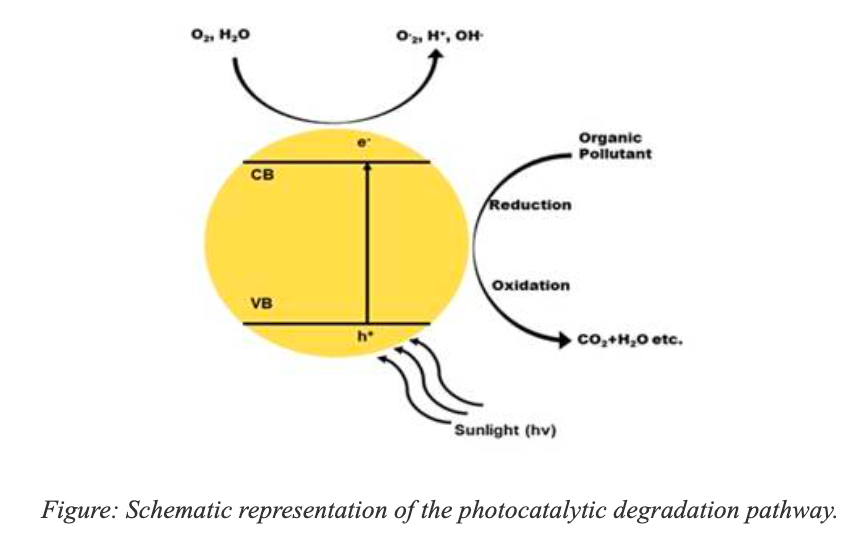
Process Overview: Photocatalytic degradation involves using a catalyst activated by light to break down organic pollutants into harmless substances like water and carbon dioxide.
Catalyst: Typically, titanium dioxide (TiO2) is widely used due to its stability, non-toxicity, and ability to absorb UV light effectively, triggering the degradation process.
Mechanism: When exposed to UV light, TiO2 generates electron-hole pairs. These reactive species oxidise organic pollutants adsorbed on the catalyst surface or in the surrounding solution.
Applications: Used in water and air purification systems to remove pollutants such as dyes, pesticides, pharmaceuticals, and volatile organic compounds (VOCs).
Advantages: Offers a sustainable and environmentally friendly method as it does not produce harmful by-products and utilises abundant sunlight or artificial UV sources.
Challenges: Effectiveness can be influenced by factors like catalyst type, light intensity, pH, and presence of other substances in the environment, requiring optimization for different
Practice Question: Discuss the significance of photocatalytic degradation in addressing environmental pollution. Highlight its applications, advantages, and challenges. (150 Words /10 marks)
2. Union Home Minister and Minister of Cooperation Shri Amit Shah holds a press conference in New Delhi on three new criminal laws, calls the laws victim-centric and justice-oriented
The enactment of Bharatiya Nyaya Sanhita (BNS), Bharatiya Nagarik Suraksha Sanhita (BNSS), and Bharatiya Sakshya Adhiniyam (BSA) on July 1 marks a significant overhaul of India’s criminal justice system, replacing archaic colonial-era laws.
These laws redefine penal offences, streamline investigation procedures, and modernise evidence gathering and trial processes nationwide.
Analysis of the news:
Here are the key improvements about the three new laws introduced as highlighted by the Union Home Minister of India:
Focus on Justice and Victim Rights:
These laws prioritise justice over punishment, aiming for speedy trials and protecting victims’ rights.
A new chapter specifically addresses crimes against women and children, with 35 sections and 13 provisions dedicated to enhancing sensitivity and legal provisions in such cases.
Mob lynching has been defined and carries severe penalties, addressing a previously unregulated crime.
Technological Integration and Modernization:
The laws incorporate advanced technology, including provisions for digital FIRs, charge sheets, and records.
Computerization of 99.9% of police stations and a move towards e-records were initiated in 2019, setting the foundation for digital law enforcement.
Forensic investigation is made mandatory for offences punishable by seven years or more, with efforts to increase the conviction rate to 90%.
Legal Reforms and Legislative Modernization:
Outdated colonial-era laws, including the sedition law, have been abolished, reflecting contemporary legal needs.
New provisions address anti-national activities, ensuring severe penalties for actions threatening India’s unity and integrity.
The legislation is available in all eight scheduled languages, promoting accessibility and inclusivity in legal proceedings nationwide.
Implementation and Training:
Over 23,000 master trainers have been trained to educate 22.5 lakh policemen on these new laws.
Judicial officials and public prosecutors have also undergone extensive training to ensure effective implementation and application of the laws.
Parliamentary Process and Public Discourse:
The laws underwent rigorous discussion in Parliament, with detailed deliberations lasting over nine hours in the Lok Sabha and over six hours in the Rajya Sabha.
Despite claims of exclusion, expelled members of Parliament had the opportunity to participate in these discussions.
These laws represent a comprehensive overhaul of India’s criminal justice system, emphasising modernization, victim protection, and efficient judicial processes aligned with contemporary technological advancements.
Practice Question: Discuss the significance of India’s recent criminal justice reforms introduced through three new laws. Highlight their key provisions and their potential impact on the legal framework and societal dynamics.(250 Words /15 marks)
1. The Uncelebrated Revolution: How Maize Transformed India’s Agricultural Landscape (Source: Indian Express; Section: Explained; Page: 14) Topic: GS3 – Agriculture Context: The Green Revolution made India self-sufficient in wheat and rice, thanks to high-yielding varieties developed by institutions like CIMMYT and IARI, under the leadership of scientists like Norman Borlaug and M.S. Swaminathan. However,…
Join 99Notes IAS Institute Get A Free Counseling By Our Professional UPSC Counsellors. Send message On Whatsapp The Green Hydrogen Mission emphasizes establishing India as a global leader in the production, usage, and export of green hydrogen. However, achieving this ambitious goal might be hindered by: Select the correct option from the following: An…
PRESS INFORMATION BUREAU 18-July-2023 Daily Current Affairs For UPSC ,The PIB ( Press Information Bureau ) Facebook-f Twitter Youtube 1. PM hails historic milestone of destruction of 1,44,000 kgs of seized drugs Topic: GS3 – Drug menace in India. Context: India achieves historic milestone in eliminating drugs: Prime Minister Narendra Modi commends the destruction of…
1. India needs an environmental health regulatory agency (Source – The Hindu, International Edition – Page No. – 8) Topic: GS2 – Governance, GS3 – Environment Context India, facing rising greenhouse gas emissions and severe pollution-induced health risks, is advocating for ambitious climate financing at COP 29. The article emphasises the need for a centralised…