State Council Of Ministers- Notes For Upsc
| |

State Council of Ministers- Notes for UPSC

State Council of Ministers In a parliamentary form of government, the Council of Ministers, headed by the Chief Minister, wields the real executive power in the political and administrative system of the state (federal unit). The Council of Ministers in the states function in a similar way as at the central level. Article 163 of…
The Chief Minister: Appointment, Oath, Power And Functions- Complete Notes For Upsc
| |

The Chief Minister: Appointment, Oath, Power and Functions- Complete Notes for UPSC

Chief Minister Article 163 of the Indian Constitution states, “There shall be a Council of Ministers with the Chief Minister (CM) at the head to aid and advise the Governor of the state in the exercise of his functions”. In the parliamentary form of government, the Chief Minister is the real executive authority in states….

Union Council Of Ministers And The Cabinet – Indian Polity Notes For Upsc
| |

Union Council of Ministers and the Cabinet – Indian Polity Notes for UPSC

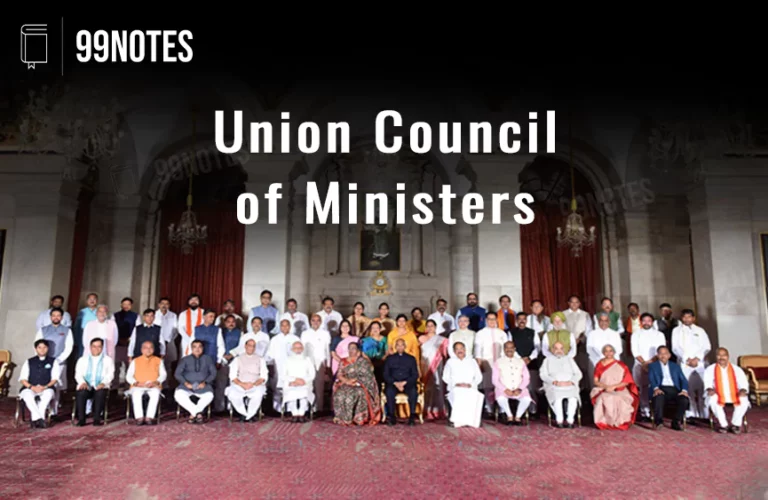
Union Council of Ministers In a Parliamentary System, the Council of Ministers (CoM) headed by the Prime Minister wields the real executive authority. Articles 74 and 75 of the Constitution deal with the power and function of the Council of Ministers. Amendments in Article 74 42nd Constitutional Amendment: “There shall be a Council of Ministers with the PM…

The Governor Appointment, Qualifications, Oath, Power And Functions
| |

The Governor Appointment, Qualifications, Oath, Power and Functions

Governor of States Article 153 of the Indian Constitution states that “there shall be a Governor for each state”. The Constitution of India establishes a Parliamentary form of Government at both central and state levels. Just as the President is the constitutional head of the state, the Governor is the constitutional head of a state…

President Of India (Article 52-62) – Upsc Indian Polity Notes
| |

President of India (Article 52-62) – UPSC Indian Polity Notes

The Parliamentary system of government is characterised by the presence of dual executives. The Union executive consists of the President, the Prime Minister, the Council of Ministers and the attorney general of India. The executive power of the government of India is vested in the President of India, who is the head of the Indian…

Prime Minister Of India And Pmo- Upsc Notes
| |

Prime Minister of India and PMO- UPSC Notes

Prime Minister of India (PM) Article 74 of the Constitution provides that “there shall be a Council of Ministers with the Prime Minister at the head to aid and advise the President who shall, in the exercise of his functions, act in accordance with such advice”. Thus, the real executive power vests in the Union…

The Vice President Of India-Upsc Notes
| |

The Vice President of India-UPSC Notes

Vice President of India Article 63 of the Indian Constitution provides that there shall be a Vice-President of India. The Vice President of India is the second highest Constitutional Post after the President. The position of the Indian Vice-President is modelled on the American Vice-President as s/he performs the dual role of Vice-President and the…

| |

Salient Features of Indian Constitution [UPSC Notes]

Salient Features of Indian Constitution The Constitution of India is a foundational document that governs India. It  is not only the highest law in the country but also a symbol of India’s values and governance. Adopted in 1950, it shapes India’s political landscape and ensures rights and freedoms for all its citizens. This article will…

Emergency Provisions
| |

Emergency Provisions

In Indian polity, Emergency refers to a situation where the Central executive exercises extraordinary powers given by the Constitution, to deal with a crisis caused by either internal or external factors that threaten the nation’s stability, unity and sovereignty. Emergency provisions are given in Articles 352 to 360 in Part XVIII of the Indian Constitution….

Reforms In Centre-State Relations

Reforms in Centre-State Relations

Despite the various provisions made in the Indian Constitution for the smooth functioning of the Indian Union, it has faced many practical challenges. Most of these challenges orbit around the demand for greater autonomy. In post-independent India, the need for planned development, national integration and maintenance of law and order led to a significant degree…